
My First E-book / Book
Twitter Shouts
- Watching NDTV. Bharka Dutt, with a heavy make-up looks as old as Hema Malini! 6 days ago
- A well deserved beer after a week long, marathon video-editing of DSLR footage to create a 3 hour video for a... http://t.co/c0alE7Ui 6 days ago
Recent Buzz on Social Media
Subscribe Newsletter
Category Archives: Stories
Stories
In the Life of Romal
‘In the life of Romal’, is an ongoing project where I am documenting the life of my friend, Laishram Romal Michael Singh. Romal is gay. Being gay isn’t the end of his identity, isn’t it? But being gay can be enough to pass a prejudiced judgement in Indian society where homosexuality is still shunned upon.
Till recently, consensual homosexual act between two adults was a crime in India. Decriminalization of homosexuality may have marked a new era of human rights in India. But, it is still a long way before majority of the population starts treating homosexual individuals as equal in the city.
Romal is a multi faceted individual. He is religious (christian) and gay at the same time, and this fascinates me because religious institutions are most often in disagreement with homosexuality.
His identities of being gay, Christian, a Manipuri, a Tamil, a friend, a writer, and so on, are being explored in this project to go beyond stereotypes on gay community existing in Indian society.
The story takes a deviation from loud, defiant form of gay activism that is generally noticed. Even defiance can become a stereotype.
Also posted in Portfolio
|
Tagged bengaluru pride, body politics, christian, documentary, friend, gay, gender, homosexual, identity, koshy's, laishram, manipuri, michael, pride march, queer, romal, singh, tamil
|
1 Comment
Chinnara Manasa : Right to participation
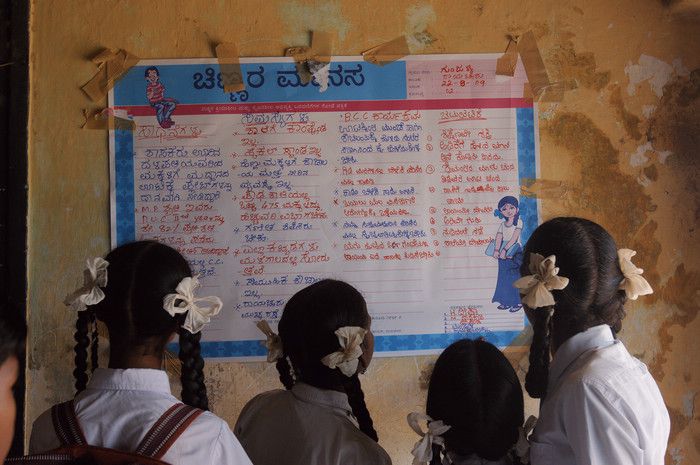
Children at Gunjalli Government High School, Raichur read the children's newsletter 'Chinnara manasa'
Prakash is a boy studying in 10th standard at Government High school Yappeldini village, about 25 kilometers from Raichur. But he lives in Donga Rampur village which is about 7 Kms away from his school and he has to cycle up and down everyday. His village school has classes only up to 7th standard. Many of Prakash’s friends form the village, mainly girls, have discontinued their studies because they find it a difficult task to cycle to their nearest High School.Prakash and his friends want the government to start a high school in his village so they can being about a change. But how will they do it? They will write about this issue in their newspaper! A newspaper which they hand-write and paste it across the walls in their village wherever people gather. It might sound childish to many, but their newspaper stories have resulted in repair of once a potholed road connecting Raichur and their village. Their newspaper Chinnara Manasa , says Prakash can make them bring about another significant change in their village.
Prakash is one of the 1143 ‘Child reporters’ of Chinnara Manasa village newsletters, mentored by UNICEF under a project spreading across 225 villages in rural areas of Raichur district in Karnataka. The project was started by UNICEF in association with the localZila Panchayat under the article 12 and 13 of United Nations Convention on the Rights of the Child ( UNCRC) which advocates right to participation. Article 12 says that every child has the right to express views on all decisions made by adults that affect children and their views must be taken into account. Article 13 states that Children have the right to get and share information, as long as the information is not damaging to them or others. In exercising the right to freedom of expression, children have the responsibility to also respect the rights, freedoms and reputations of others. The freedom of expression includes the right to share information in any way they choose, including by talking, drawing or writing.
Raichur is one of the most backward districts on Karnataka and with most people being illiterates there is lack of knowledge about health care, sanitation, education and rights. The project began with the hope of making the children to be the agents of change in Raichur.Abid Ahmed , child reporters Coordinator at Raichur, says ” Master trainers appointed by UNICEF to identify and make teams of 5 children from every village in all the high schools in this region. Students who are confident and interactive are identified and picked up to be child reporters. One day training class is held Theoretical classes are conducted on editorial policies and the way the news is to be gathered and reported. We concentrate on the language the children need to use in writing content for Chinnara Manasa newsletter. We stress them to use terms which their local villagers will be familiar with. We ask them to avoid difficult words. Also we tell them to write in big and bold letters, so that people standing at few feet distance away from the wall where the newsletter is pasted, should be able to read it. We also instruct them to avoid names of individuals and focus more on the issues.”
The program has helped in building the writing and observation skills of the children, and in making them aware of their rights. They are slowly beginning to question everyone from administrators in their schools, to local village Panchayat and to bureaucrats. Vikas Verma, Communication Specialist UNICEF says, “The basic idea of the project is that children must take part in issues in their community that affect them. They have a role to play in solving these issues at one end. And secondly, by making them look at these issues from a new perspective, we hope they would grow up to become adults who would then be able to address these issues in the same manner among their children. So it is a long term process.”
Lot of changes have been brought about by the activities of these child reporters. Cemented roads are getting built in villages, water related issues seem to be getting solved and facilities in schools seem to be improving.Thirumala reddy, a child reporter from Vadepalli village says, “The bore wells and hand pumps in our village were not operational. We wrote about it and finally a month back they repaired one hand pump in Vadepalli and now the villagers are able to get water for daily needs from it. We are really thrilled about it.” Narasimhaa, a child reporter studying in Gunjalli village says, “The work of Ramalingeshwara Gudi temple in our village had stopped. After we wrote about it ,the work has started again. Also our article has resulted in cemented roads being built in our village.” Still a lot need to be done though. Children are writing about need of more classrooms, more teachers, better toilets in schools and villages, building of drains, power supply and even more. They are hoping that it will be just a matter of time when these issues get addressed.
Not all is hunky dory though. Like every other journalistic venture even this newsletter of children has faced stiff resistance testing their determination and courage. “In a particular village, the Gram Panchayat members had confronted the children and their families, after the children wrote about problems in their village. Finally, when they realized that the program was done in association with Zilla Panchyat they had no option but to keep quite and solve the problems highlighted by the children.” says Farzana the taluk level Coordinator of the program at Raichur Taluk. A child reporter in Kudlur village said, “We wrote that people in our village need buses and then pasted the Chinnara Manasa Patrike on the walls here. Some auto drivers who were afraid of their business getting affected with the start of bus service, tore the newsletter and threw it to the garbage in front of us. Also most people don’t know to read and write and hence do not understand that we are writing issues mattering to them. They simply tear it like they tear away any movie poster. Also, children are given contact numbers of master trainers so that they can always be contacted if any issues come up during and after the newsletter is made.”
Raichur is
one of the most backward districts on Karnataka and with most people being illiterates there is lack of knowledge about health care, sanitation, education and rights. The project began with the hope of making the children to be the agents of change in Raichur.Abid Ahmed , child reporters Coordinator at Raichur, says ” Master trainers appointed by UNICEF to identify and make teams of 5 children from every village in all the high schools in this region. Students who are confident and interactive are identified and picked up to be child reporters. One day training class is held Theoretical classes are conducted on editorial policies and the way the news is to be gathered and reported. We concentrate on the language the children need to use in writing content for Chinnara Manasa newsletter. We stress them to use terms which their local villagers will be familiar with. We ask them to avoid difficult words. Also we tell them to write in big and bold letters, so that people standing at few feet distance away from the wall where the newsletter is pasted, should be able to read it. We also instruct them to avoid names of individuals and focus more on the issues.”
The program has helped in building the writing and observation skills of the children, and in making them aware of their rights. They are slowly beginning to question everyone from administrators in their schools, to local village Panchayat and to bureaucrats. Vikas Verma, Communication Specialist UNICEF says, “The basic idea of the project is that children must participate in issues in their community that affect them. They have a role to play in solving these issues at one end. And secondly, by making them look at these issues from a new perspective, we hope they would grow up to become adults who would then be able to address these issues in the same manner among their children. So it is a long term process.”
Lot of changes have been brought about by the activities of these child reporters. Cemented roads are getting built in villages, water related issues seem to be getting solved and facilities in schools seem to be improving.Thirumala reddy, a child reporter from Vadepalli village says, “The bore wells and hand pumps in our village were not operational. We wrote about it and finally a month back they repaired one hand pump in Vadepalli and now the villagers are able to get water for daily needs from it. We are really thrilled about it.” Narasimhaa, a child reporter studying in Gunjalli village says, “The work of Ramalingeshwara Gudi temple in our village had stopped. After we wrote about it ,the work has started again. Also our article has resulted in cemented roads being built in our village.” Still a lot need to be done though. Children are writing about need of more classrooms, more teachers, better toilets in schools and villages, building of drains, power supply and even more. They are hoping that it will be just a matter of time when these issues get addressed.
Not all is hunky dory though. Like every other journalistic venture even this newsletter of children has faced stiff resistance testing their determination and courage. “In a particular village, the Gram Panchayat members had confronted the children and their families, after the children wrote about problems in their village. Finally, when they realized that the program was done in association with Zilla Panchyat they had no option but to keep quite and solve the problems highlighted by the children.” says Farzana the taluk level Coordinator of the program at Raichur Taluk. A child reporter in Kudlur village said, “We wrote that people in our village need buses and then pasted the Chinnara Manasa Patrike on the walls here. Some auto drivers who were afraid of their business getting affected with the start of bus service, tore the newsletter and threw it to the garbage in front of us. Also most people don’t know to read and write and hence do not understand that we are writing issues mattering to them. They simply tear it like they tear away any movie poster. Also, children are given contact numbers of master trainers so that they can always be contacted if any issues come up during and after the newsletter is made.
Also posted in Non-profits, Portfolio
|
Tagged child rights, children, chinnara manasa, developmental, documentary, journalism, Karnataka, NGO, photo essay, photography, Portfolio, raichur, uncrc, unicef
|
1 Comment
Visthar
Visthar is a secular, non-profit organization, committed to enabling women, children and other marginalized sections realize their rights. Visthar campus is located at dodda gubbi post on the outskirts of Bangalore city. One of the projects at Visthar is Bandhavi – an initiative for girls hailing from North Karnataka and Andhra Pradesh, who are at risk of being dedicated as devadasis. It is a residential school program that enables the rescued girls to grow as individuals, as well as build a community that lives in love, respect, trust and friendship.
Also posted in Non-profits, Portfolio
|
Tagged bandhavi, children, documentary, girls, India NGO Photographer, India non-profits photographer, NGO, NGO Photography, non-profit, rehabilitation, social work, visthar
|
Leave a comment
Of Love and Longing
India, the home of over one billion people is a third world economy. One of the problems of the third world is unemployment, and with one billion people having few job openings, it is natural for huge number of people migrating overseas in search of opportunities to make a living and earn a better life. But migration comes with its own pros and cons. Some people attain success and some don’t. Some find themselves alienated in a different culture while others find acceptance. Some people can embrace change making peace with self and the newfound land where as others spend their lives struggling hard and yet longing for what they consider as their real home. The brand Angkor and Cambodia opened up as a new market in the last decade of 20th century after years of violence. With tourism industry booming in Cambodia, the nation became a preferred choice for many people to head there for business. Lot of Indians too followed the suit. Among them was Dharmanand Sharma, an enterprising Indian chef from the foothills of Himalayas. Sharma had years of experience working in hotels of Mumbai, Delhi and The Middle East. Sharma was well aware of the growing popularity of Indian food. With the hope of getting into restaurant business he first entered Cambodia in 1997. In the last 12 years, Sharma’s fortunes went up and down many times but ultimately he was able to set-up a successful Indian restaurant named ‘New Delhi’ in Siem Reap. And it wasn’t just excellence in profession which Sharma found in a foreign land, he also found love. Sharma found a companion in Soni, a Khmer woman. Sharma, an Indian Hindu and Soni a Khmer Buddhist, are now man and wife with each retaining their cultural identities and yet at the same time embracing new ideas to raise their multicultural family with two children. Sharma and Soni together run the restaurant business. At the opposite end of the spectrum are Indian salesmen who migrated from Gorakhpur and other rural areas of Uttar Pradesh province in northern India. Most of them have little education and were doing in low skilled jobs back in their hometowns. With limited opportunities back home, they followed one another to Siem Reap and other places in South East Asia in search of jobs that could give them better salary. Back in India, a sales rep job was always looked down upon by their friends and family. In Cambodia, they really have no relatives to pass judgement on their vocation and are happy to earn a lot more than they would have earned in India. But their work involves travelling across Cambodia carrying garments, toys, mosquito nets, watches, small electronic goods other small items and trying to sell them at door steps of peoples home. Their families are all back in India and these salesmen have only themselves to keep company. Their work brings them money but not much happiness. They find their work extremely tiring and monotonous and are unable to find alternative to what they do. They have not been able to accept Cambodia completely.
Also posted in Portfolio
|
Tagged angkor, apf workshop 2008, cambodia, documentary, indians, migrants, migration, siem reap
|
Leave a comment


Latest Comments